Fashion and the British Connection in Antwerp
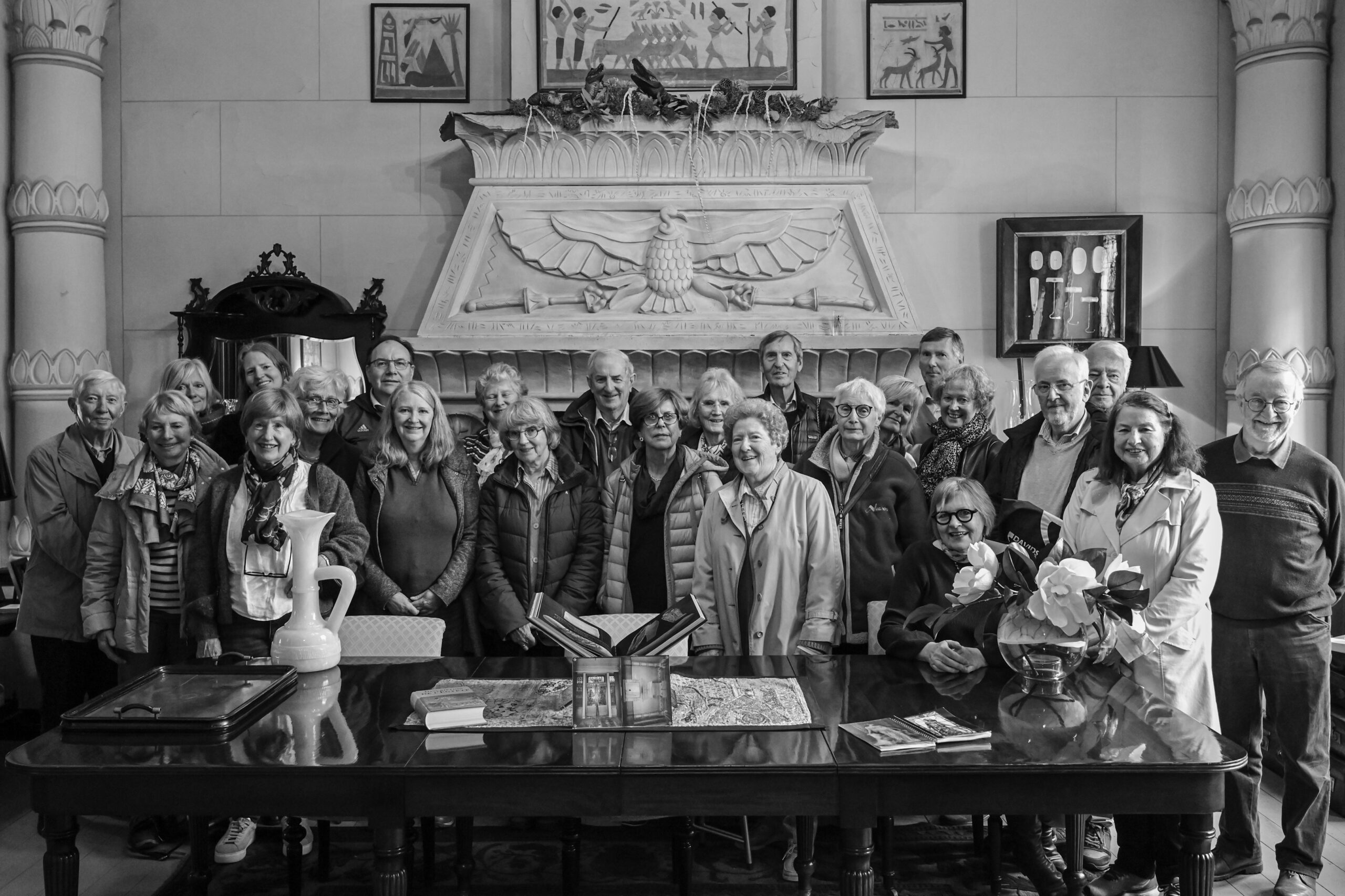
A report by Robert Adams on the NTAB visit to Antwerp on February 21.
A. Fashion in Antwerp
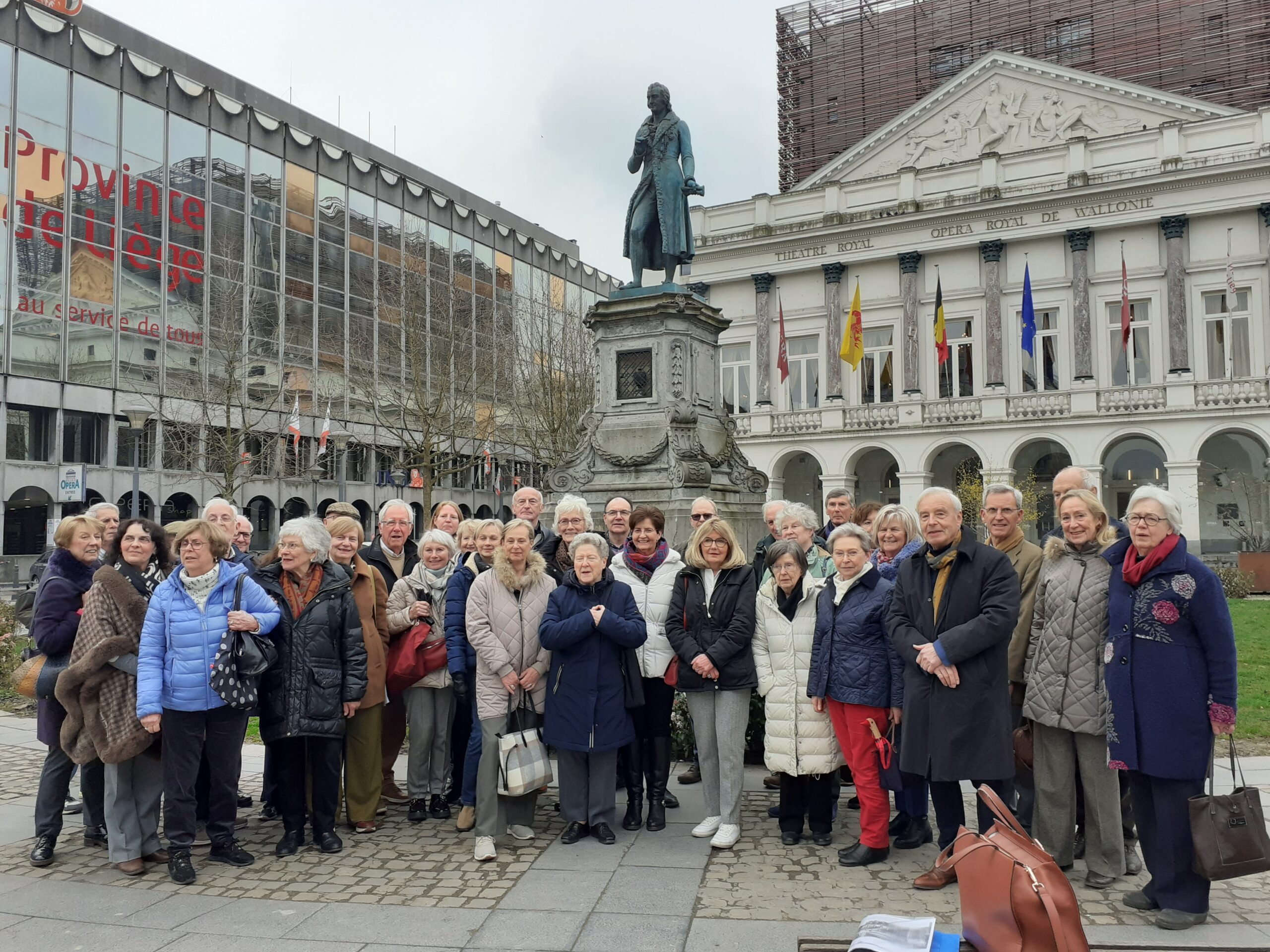
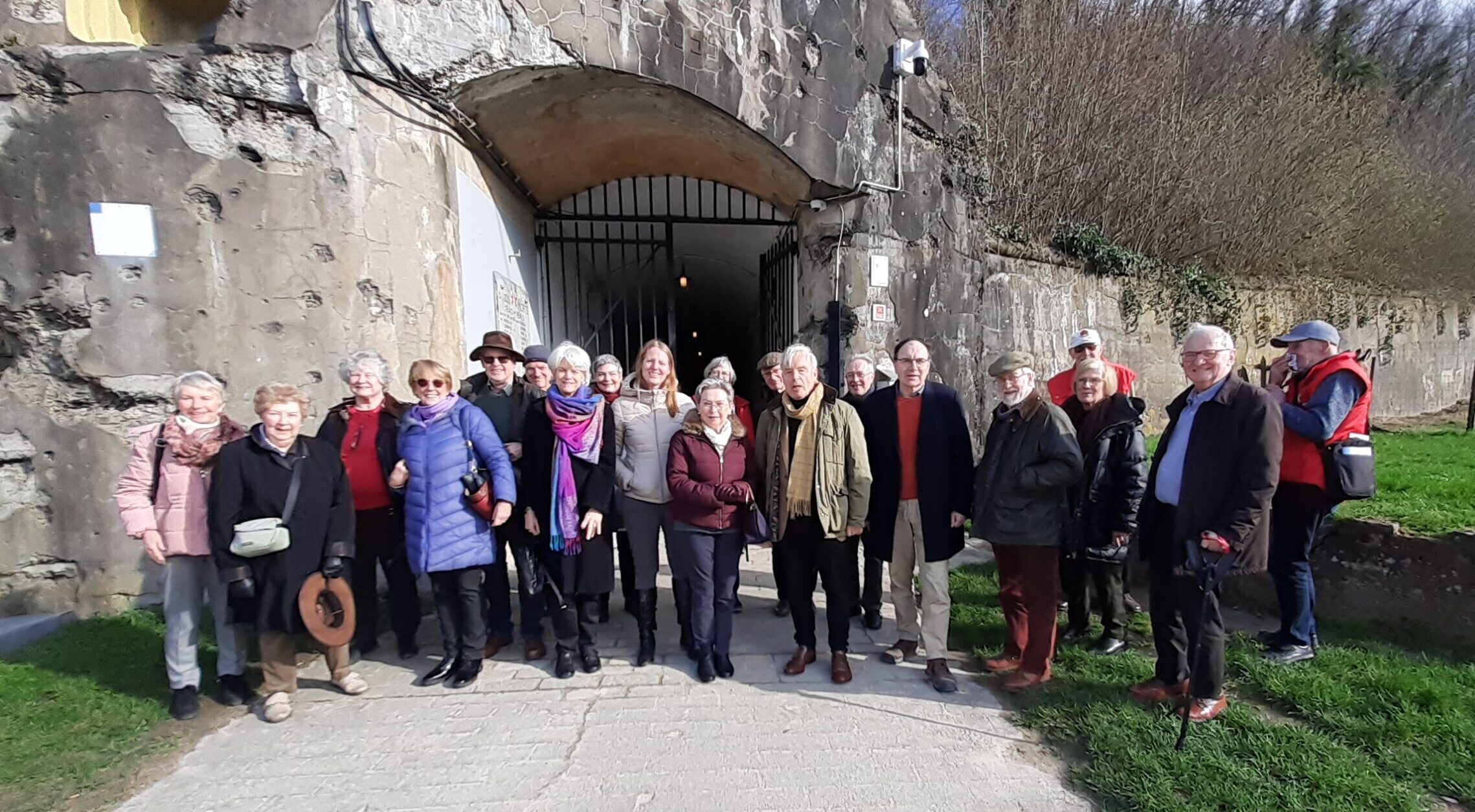
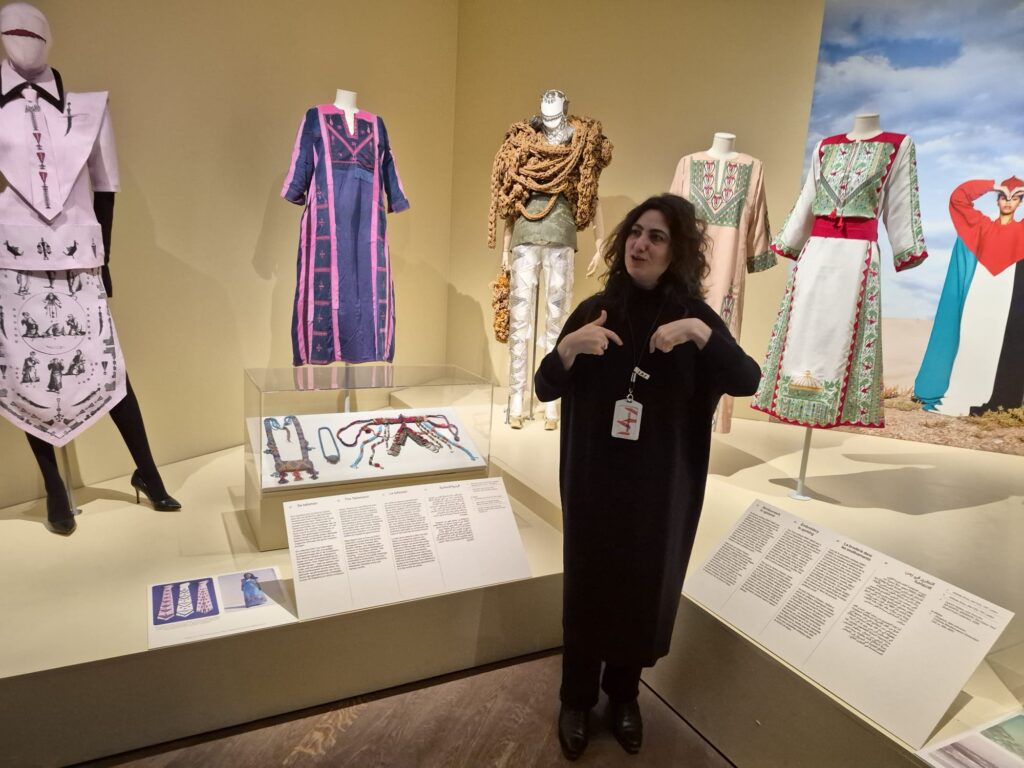
We spent the whole of this part in the “MoMu” Fashion Museum, where the party (of 36) met up together in the café there. We were then guided through the museum by an excellent guide who described very interestingly the the history of fashion in Antwerp and all about each of the exhibits.
A 1. Palestinian Fashion
She started us with a special separate exhibition of Palestinian fashion on loan from museums in Paris, Leiden and the Netherlands, celebrating the rich cultural heritage of Palestine’s past alongside the designers shaping its future.
Embroidery, called tatreez in Arabic, is one of the most important cultural practices of Palestine. Historically, Palestinian fashion was defined by diversity, with every region known for distinct textiles, styles and stitchwork. More than a craft, tatreez in the nineteenth and early twentieth centuries was a visual language shared by women, as embroidery reflected its maker’s identity and origins.
Tatreez was a rural craft, embedded in women’s relationship to nature – from motifs inspired by Palestinian flora, to fabrics dyed with indigo grown in the Galilee. At the same time, the splendour of embroidery attested to women’s wealth and status. The wedding was a vital rite of passage, with sumptuous clothing a key element of celebrations. Golden thread, mother-of-pearl shoes, and elaborate headdresses offer a spectacular glimpse of local craftsmanship.
Today, embroidery’s power lies in its connection to Palestinian identity, as a symbol of resistance and solidarity. Since the Nakba, or catastrophe, of 1948, which refers to the mass displacement and dispossession of hundreds of thousands of Palestinians, and the establishment of the state of Israel, tatreez has become a form of cultural resistance, an assertion of identity.
The most atonishing fact about this embroidery is the enormous manual work involved – each dress might take several years to make, consisting of thousands of stitches !!
A 2. Belgian Fashion
The collection presented on the ground floor sheds light on avant-garde Belgian and international fashion, together with an alternating presentation of silhouettes and archive material from the museum’s collection of more than 38,000 items. The selection will change regularly to display as much of the MoMu Collection as possible, from contemporary fashion to historical clothing, textiles and accessories.
Today, the renovated museum can give the history of Belgian and international fashion a permanent place. The MoMu Collection is continuously enriched as the gaps within the historical collection are filled and creations by emerging talent are added.
Being taken expertly through the collection by our guide, we discovered the development of avant-garde Belgian and international fashion. The exhibition presents clothing and accessories, show invites, and archival footage. An introductory documentary takes a deeper look at the origins of the quality label ‘Belgian fashion’ from the rise of the Antwerp Six in the 1980s, Dries Van Noten, Martin Margiela, Raf Simons, Walter Van Beirendonck, Ann Demeulemeester, Dirk Van Saene The work of students from the Fashion Department, presented every year, highlights the importance of the Royal Academy of Fine Arts Antwerp.
A 3. Antwerp Fashion Academy
The Fashion department of the Antwerp Academy is internationally known for its idiosyncratic approach to fashion as a creative process. This charisma creates a great international appeal, as a result of which the majority of our fashion students come from abroad. Each student is supervised individually and enters into dialogue with a team of lecturers who are experts in their field. They stimulate the future fashion designer to think critically, develop a personal signature and work autonomously. Creativity and authenticity are central to this.
B. The British Connection
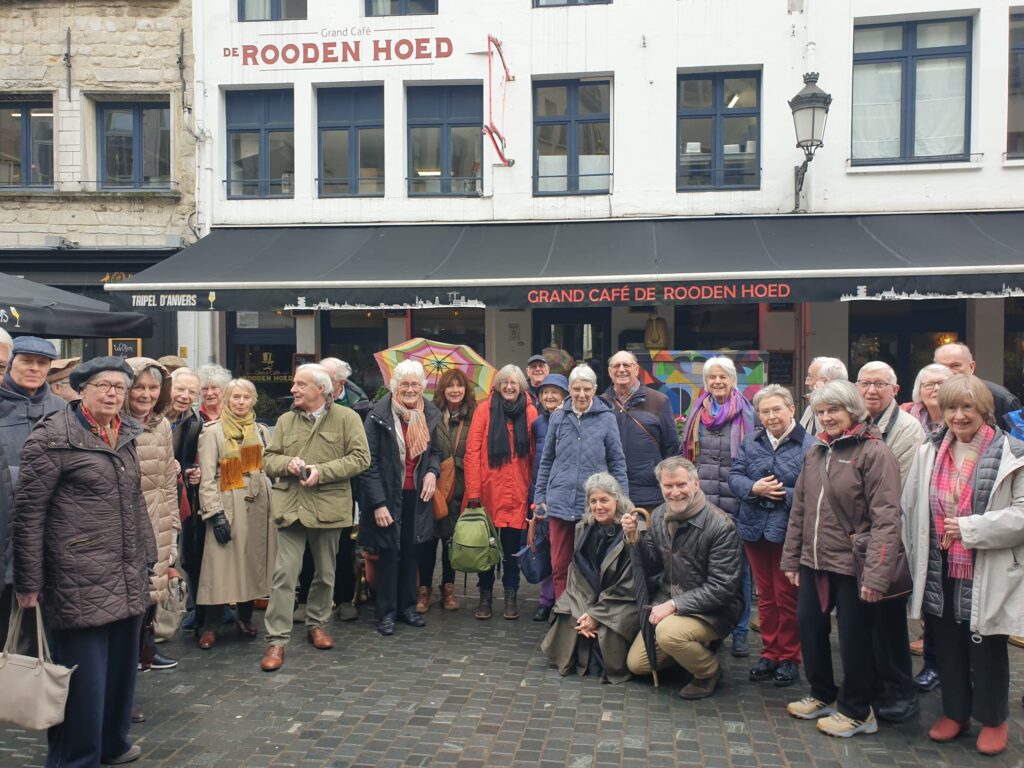
After a very pleasant lunch at an old restaurant called “Grand Café de Rooden Hoed” on the Korenmarkt, we joined the English-speaking guide named “Fred,” who had gathered an incredible collection of trivia directly related to British topics.
By the 15th century, Antwerp, located in the heart of Western Europe, emerged as the commercial capital of northern Europe, largely due to its strategic position at the crossroads of major trade routes connecting France, the Holy Roman Empire, and the North Sea. The city’s rise coincided with the decline of Bruges, which had been the region’s leading harbor, but became less navigable. Antwerp attracted diverse merchants, of which the most important were English and German, and became a hub for trade, finance, and culture, featuring the establishment of its own ‘borse’, the precursor to modern stock exchanges. Today, it stands as a key global port and cultural center.
What makes Antwerp so famous? Antwerp seems to be known mainly for the diamond trade but there are also beautiful buildings and a history of many accomplished painters such as Anthony van Dyck, Pieter & Jan Brueghel and Pieter Paul Rubens.
Our guide Fred took us on a tour of the city, visiting various places and explaining each one’s British connection.
- He told us about the long, interconnected history between Antwerp and England, which stretches from the textile trade in the 16th century to the crucial liberation during the Second World War and modern economic ties.
- As a top 10 trading partner, the port of Antwerp is crucial to the British economy, while English is widely spoken in the city today, reflecting a cosmopolitan culture.
B 1. Sir Thomas More
In 1515, Sir Thomas More visited Antwerp as part of a diplomatic mission for King Henry VIII to negotiate trade relations. During this stay, he met with scholars and merchants, forming the backdrop for his masterpiece, Utopia (1516), which is famously set in Antwerp.
We visited a metal plaque in the Handschoenmarkt which records how More on 1515 met a traveler who told him about Utopia which is supposed to have given him the idea of writing in 1516 his famous book.
Thomas More was executed by Henry VIII for treason (because he did not accept the secession from the Catholic Church).
B 2. Wool and Cloth
We visited the Wolstraat and Hofstraat. This district was the centre of the trading offices, galleries and warehouses, especially of the English cloth merchants. By 1504, Antwerp was a major hub where English wool and cloth was traded alongside spices and other goods.
In medieval England, wool became big business. There was enormous demand for it, mainly to produce cloth. The English raised an enormous number of sheep, but they made little cloth themselves. It was the raw wool from English sheep that was required to feed foreign looms. At that time the best weavers lived in Flanders and the rich cloth-making towns of Bruges, Ghent and Ypres were ready to pay top prices for English wool. This wool trade became the backbone of the medieval English economy between the late thirteenth century and late fifteenth century
To this day the seat of the Lord High Chancellor in the House of Lords is a large square bag of wool called the ‘woolsack’, a reminder of the main source of English wealth in the Middle Ages.
B 3. Military Significance
- The Scheldt River, which connects to the Rhine Delta, made Antwerp a vital, strategic location for the British, who recognized that control of this deep-water port could prevent a Spanish or French invasion of England.
- World War II: The British liberated Antwerp in September 1944. This led to a “figurative colonization” of the area by the British Empire, with locals fondly referring to soldiers as “our Tommies”.
B 4. William Cavendish 1st Duke of Newcastle
After fighting for the King in the English Civil War, William Cavendish fled to the continent and eventually settled in Antwerp, renting the house of the late painter Peter Paul Rubens (now the Rubens House Museum), with his wife Margaret. They navigated severe financial difficulties while maintaining a culturally rich lifestyle. He ran a horse-riding school and she wrote and published several works during this period.
B 5. Anthony Van Dyck
Antoon Van Dyck was a great painter, also born in Antwerp and living there at the same time as Rubens. So they were rivals, competing with each other. That was one reason why Van Dyck spent quite some time in England with the English court. It is generally accepted that Van Dyck elevated painting to a full-fledged art form in England and set a model for aristocratic portraiture. For this, he was knighted by the English court and given the title Sir Anthony Van Dyck.
B 6. Mary Tudor Queen of England 1554 -58
Fred showed us a portrait of Mary Tudor made by Anthonis Mor, a Dutch painter with workshops in Utrecht and Antwerp.
After the death of Edward VI, King of England, in July 1553, Holy Roman Emperor Charles V brokered a royal marriage between Spain and England, allying his son Philip with the successor to the English throne, Mary Tudor. During these negotiations, Mor was sent to England in 1554 to paint a portrait of Mary.
B 7. Mary Queen of Scots
St. Andrew’s Church (Sint-Andrieskerk) in Antwerp houses a significant 17th-century monument to Mary, Queen of Scots, commissioned by two of her loyal ladies-in-waiting, Elizabeth Curle and Barbara Mowbray-Curle. These ladies settled in Antwerp after Mary’s execution, creating this memorial to honor her as a Catholic martyr. Mary, Queen of Scots, was executed by beheading on February 8, 1587, because found guilty of plotting to assassinate her cousin, Queen Elizabeth I.
B 8. The Antwerp “Borse” (stock Market)
At the end of the afternoon Fred took us into the current Handelsbeurs building.
- The Borse (bourse, now the ‘Handelsbeurs’) in Antwerp opened in 1531 as the world’s first purpose-built commodity exchange. The Antwerp Stock Exchange has been described as “the mother of all stock exchanges”.
- In 1565 Thomas Gresham made a proposal to the City of London’s Court of Aldermen to build, at his own expense, a bourse or exchange – which became the Royal Exchange. The architectural design of the Royal Exchange in London was inspired by the Flemish style of the Antwerp Stock Exchange building. Thomas Gresham was an English merchant and financier who often visited Antwerp and acted on behalf of King Edward VI (1547–1553) and Edward’s half-sisters, queens Mary I (1553–1558) and Elizabeth I (1558–1603).
- Following a fire in 1858, the building was reconstructed, and from 1872 once again served the purpose of housing a true stock exchange, the Antwerp Stock Exchange.
- In 1997 this stock exchange merged into the Brussels Stock Exchange (presently Euronext), so the building is now used for fairs and events.
- Earlier this month, on February 11th, the ‘Handelsbeurs’ hosted the European Industry Summit. European industry leaders and policymakers met in Antwerp to discuss the future of Europe’s industrial competitiveness. The event is closely linked to the Antwerp Declaration, a joint appeal from European industry calling for competitiveness to be placed at the core of EU policymaking.