Please find driving directions below the main text
Bank account of “National Trust Belgium” (NTAB)
BE17 0016 2443 2021
Workhouse & vagrant community at Merksplas / Wortel
Those who took part in our UK trip in 2024 will certainly remember our visit to the Southwell Workhouse, the way poverty and homelessness were dealt with in 19th-century England during the reign of Queen Victoria.
In the same period The United Netherlands (currently The Netherlands and Belgium) were also confronted with widespread poverty and homelessness among a large part of the population.
At the beginning of the 19th century, the Dutch government launched a large-scale social experiment to eradicate poverty with the foundation of the “Maatschappij van Weldadigheid” (‘Benevolent Society’)
Under the supervision of Johannes Van den Bosch, a Dutch politician and military man, the establishment of 7 colonies started in 1812. Five of them were laid out in the north of the Netherlands, two (Merksplas and Wortel) in the south near the current Belgian–Dutch border.
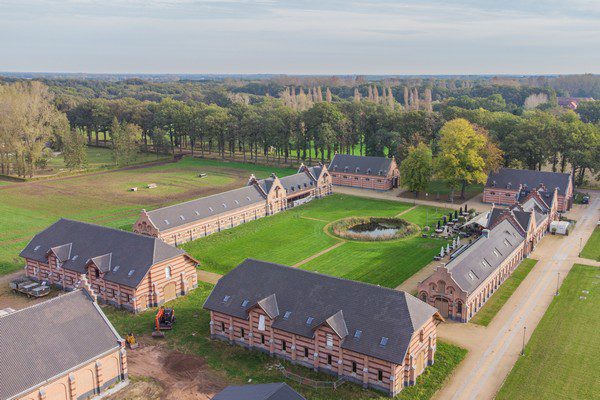
In free colonies, such as Wortel, poor families were housed on small farms with the aim of becoming self-sufficient. However, they had the right to leave the colony.
Unfree colonies, such as Merksplas consisted of a central institution where thousands of colonists were put to work. Vagrants, beggars and orphans were admitted, sometimes by force.
After Belgium gained independence in 1830, this project was discontinued because the Belgian Government lacked the financial resources to continue it.
A few decades later, however, it was revived when the Act on the Suppression of Vagrancy and Begging was passed in 1866.
From 1870 onwards, large numbers of people were sent to the Rijksweldadigheidskoloniën (State Benevolent Colonies, or Workhouses) in Merksplas and Wortel to work in agriculture, attend school and learn discipline.
Between 1878 and the end of the 19th century, important expansions followed, such as the main building, a hospital, a cell prison and a school. The monumental “Grote Hoeve” (great farm) and the Vagrants’ Chapel were designed by architect Victor Besme.
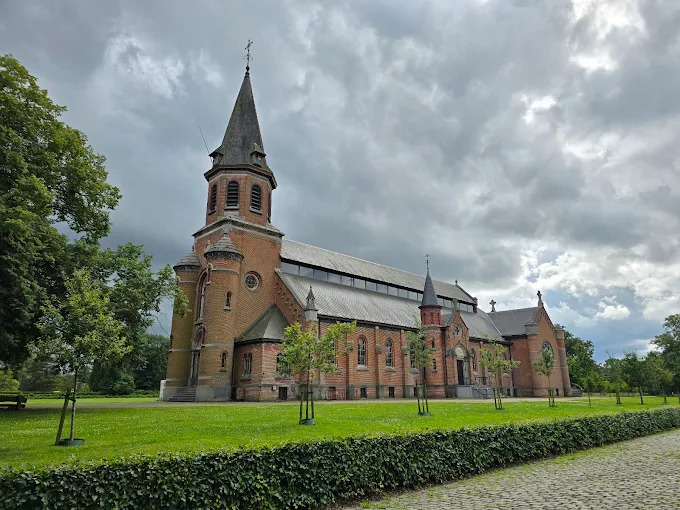 (The Vagrants’ Chapel)
In 1993, the law on vagrancy was abolished in Belgium, bringing an end to this system.
Merksplas-Kolonie has been a protected landscape since 1999. The remaining buildings underwent careful restoration and were given a new purpose such as the visitor centre, the prison museum, a brasserie, a hotel and various event locations.
The former dormitories of the vagrants now house a prison and a centre for people without residence permits.
Programme of the day
- 9:45: Welcome coffee/tea with a slice of “landloperskramiek” (‘vagrant raisin bread’) in the reception area of the prison museum.
- 10:15 – 12:15: Guided visit (EN/NL) of the prison museum and screening of a film about the last days of Wortel colony before its final closure in 1993.
- 12:15: Departure to the restaurant Lindehoeve, Veldenbergstraat 97, 2330 Merksplas for lunch. Menu: Soup, salmon with vegetables/puree, one drink (water, soft drink, beer or house wine) and coffee or tea after the lunch. Vegetarian or gluten free meals will be served to participants who indicated this at the time of registration.
- 14:15: Departure to the Merksplas colony.
- 14:30 – 16:30: Guided walk (EN/NL) along the historical heritage of the Vagrants colony in Merksplas.
- 16:30: Free visit to the Visitors Centre where we learn more about the daily life of the vagrants who once lived here.
There is an opportunity to have a farewell drink in the Colony 7 brasserie next to the visitor centre.
How to get there:
Because Merksplas is difficult to reach by public transport, the organizer would greatly appreciate it if participants would offer a lift to less mobile participants.
By car:
– Coming from most regions: Take the Antwerp ring (E19) and follow the signs for Breda. Take exit 3 (Malle) and follow the N115 and N131 towards Rijkevorsel and Merksplas (94 km from Brussels, +/- 1h40 driving time).
Note:
NTAB is an officially affiliated Supporter Group of the National Trust of England, Wales & Northern Ireland.
The fee for this outing includes a portion allocated to our annual donation to the National Trust.
The National Trust is internationally recognized as a leading organization in heritage conservation, setting the global standard in preserving historic places, beautiful landscapes and cultural treasures for generations to come.