Please find driving directions below the main text
Bank account of “National Trust Belgium” (NTAB)
BE17 0016 2443 2021
Tournai, Roman and Merovingian roots
One of the oldest cities in Belgium, Tournai is historically Flemish and nowadays administratively part of Wallonia.
Tournai developed around the junction of two Roman roads and the river Scheldt. In the 5th century, Tournai came into the possession of the Salian Franks, and under Childeric I it became the capital of the Frankish Empire. Childeric’s son, Clovis, regarded as the founder of the Merovingian dynasty of France, and described by Charles de Gaulle as “the first king of what would become France”, was born in Tournai. Clovis moved the seat of power to Paris, but a later French king made Tournai the seat of the county of Flanders. In the 14th century, in the early years of the Hundred Years’ War, the city was besieged by King Edward III of England. The siege was unsuccessful and bankrupted Edward. In the early 16th century, Tournai was captured by King Henry VIII of England, and it became, for a few years, the only city in present-day Belgium ever to be ruled by England.
During the following centuries, Tournai survived sieges by Spain, England (again!) and France, and it changed hands several times, before becoming part of the United Netherlands after the Napoleonic wars, and, accordingly, part of Belgium in 1830. Much of the city was devastated by aerial attack in May 1940. Fortunately, many buildings survived despite the enormous destruction, including the cathedral with its 12th century origins.
We shall have a guided walking tour of the historic town centre. We shall visit the majestic cathedral, famous for its five towers, which can be seen from almost everywhere in the town. It is the only Belgian cathedral listed by UNESCO as a world heritage site. Tournai is known as La Cité des Cinq Clochers because of its cathedral.
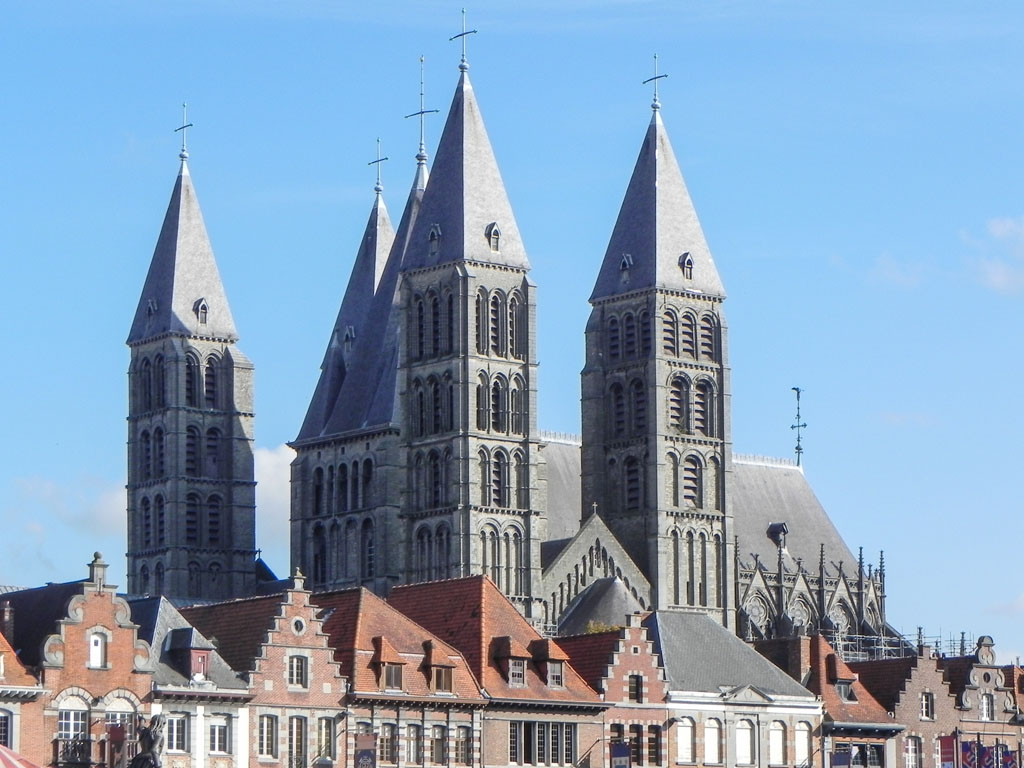
Tournai cathedral
A cathedral was first built on the site of the current cathedral in the 5th century. The current cathedral, the third on the site, was begun in the 12th century, in Romanesque style. It was substantially redeveloped in Gothic style in the 13th and 14th centuries. The cathedral survived the bombardment of May 1940, but was badly damaged. A tornado caused further damage in 1999 and revealed the fragility of the foundations. Emergency work stabilised the building temporarily, and a substantial programme of work began in 2006 and continues today.
The nearby belfry, the oldest in Belgium, built in the 12th and 13th centuries, is also a UNESCO world heritage site.
The splendid Cloth Hall on the Grand-Place, built in 1610 in Renaissance style, was rebuilt to the original plans following substantial damage in the 1940 bombardment of the town.
In the afternoon, we shall have a guided tour of the Musée des Beaux-Arts. The only museum designed as such by Victor Horta, its highly original turtle-shaped plan is an interesting example of the transition between Art Nouveau and Art Deco-inspired modernism. The museum houses the only two works by Manet on display in Belgium, as well as works by Monet, Seurat and Van Gogh, and the modern art collection of Henri Van Cutsem. There are also works by Flemish primitives, including Rogier Van der Weyden, who was born in Tournai and went on to become the official painter (stadsschilder) to the city of Brussels under Philip the Good, at a time when Brussels was the principal residence of the powerful Dukes of Burgundy.
The day will begin with coffee and a croissant, there will be a three-course lunch, and those who wish are invited to share a farewell drink near the Grand-Place.
Programme:
10.00: welcome coffee or tea and croissant at Hôtel Hemera, place Saint-Pierre 2.
10.35: film on the history of the town at the Office du Tourisme, place Paul-Émile Janson 1.
11.00: guided visit of the old town: EN and FR
12.30: lunch at restaurant l’Îlot Doré, rue Dorez 13b
14.30: guided visit of the Musée des Beaux-Arts: EN and FR
16:30: optional farewell drink at l’Impératrice, rue des Maux 12b
How to get there:
By train: The Hôtel Hemera is a 12-minute walk from Tournai station.
By car:
- From Brussels, E19 then E429, or E19 then E42, about 1h30.
- From Antwerp or Ghent, E17 then E403; from Antwerp about 1h30, from Ghent about 1h.
Parking:
- Q-Park Fort Rouge, rue Perdue, about €8 for the day. An 8-minute walk to the Hôtel Hemera.
- Parking Reine Astrid (street level), place Reine Astrid, €0,50 per half-hour, free after 12:30. Also an 8-minute walk.
- Parking Esplanade de l’Europe (street level), avenue des Frères Rimbaut. 390 places. Free. A 15-minute walk to Hôtel Hemera.
- Street parking in the centre of town: €0,50 per half hour, free after 12:30. (Avoid the Grand-Place: twice the price and limited to 2 hours.)
Note:
NTAB is an officially affiliated Supporter Group of the National Trust of England, Wales & Northern Ireland.
The fee for this outing includes a portion allocated to our annual donation to the National Trust.
The National Trust is internationally recognized as a leading organization in heritage conservation, setting the global standard in preserving historic places, beautiful landscapes and cultural treasures for generations to come.