Please find driving directions below the main text
Bank account of “National Trust Belgium” (NTAB)
BE17 0016 2443 2021
Brugse Ommeland: Oostveld garden & Loppem House
The “Brugse Ommeland” or the hinterland of Brugge (Bruges) is an area brimming with history, known for its unique scenery, lush greenery and serene and peaceful settings, and timeless villages. It’s a land where you come across numerous historic castles and abbeys as well as romantic and picturesque gardens and parklands.
How better to enjoy the delights of the Ommeland than by visiting one of its great gardens and exploring a fairytale ‘castle’ (kasteel/château) with its own labyrinth.
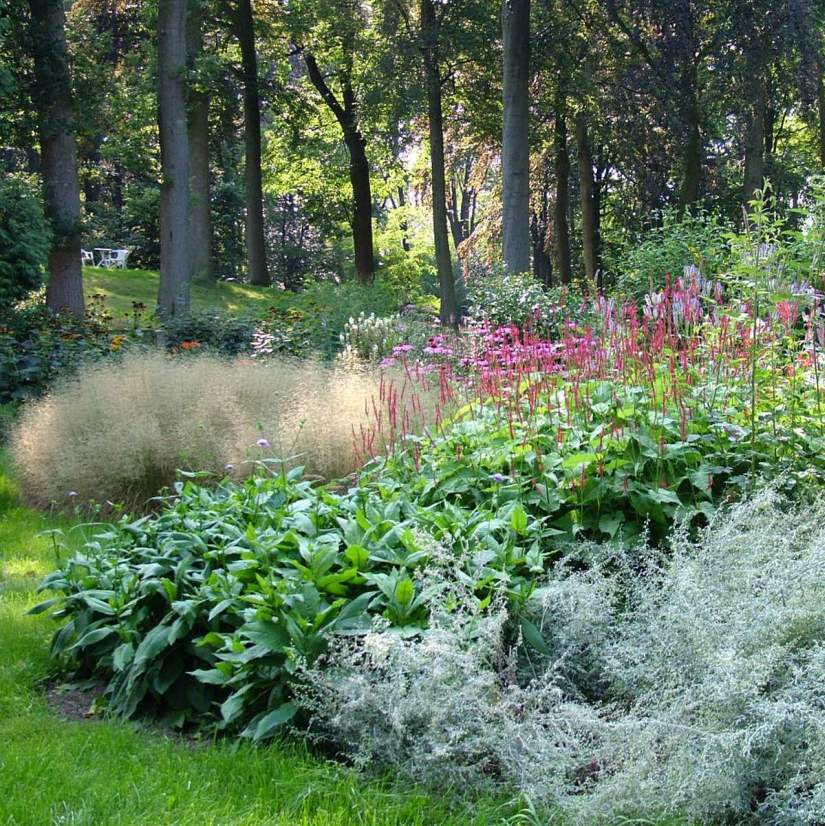
“Tuin Oostveld” is a large private garden located in the Oostveld area of Oedelem and is the creative work of landscape architect Chris Ghyselen and famous for its naturalistic and richly planted design. It has a wide variety of herbaceous plants (perennials), grasses, shrubs and ornamental species, arranged in flowing beds and borders that give structure and seasonal interest and colors. While in early summer, softer, pastel tones dominate, in late summer and autumn the garden becomes vibrant with bolder blooms (e.g. Persicaria and Helianthus species).
A defining characteristic is how the garden transitions naturally into the rural fields and landscape around Oostveld, creating a seamless flow between cultivated and wild areas.
The layout includes playful hedges, a flower meadow and water features which add to the atmosphere and biodiversity of the place.
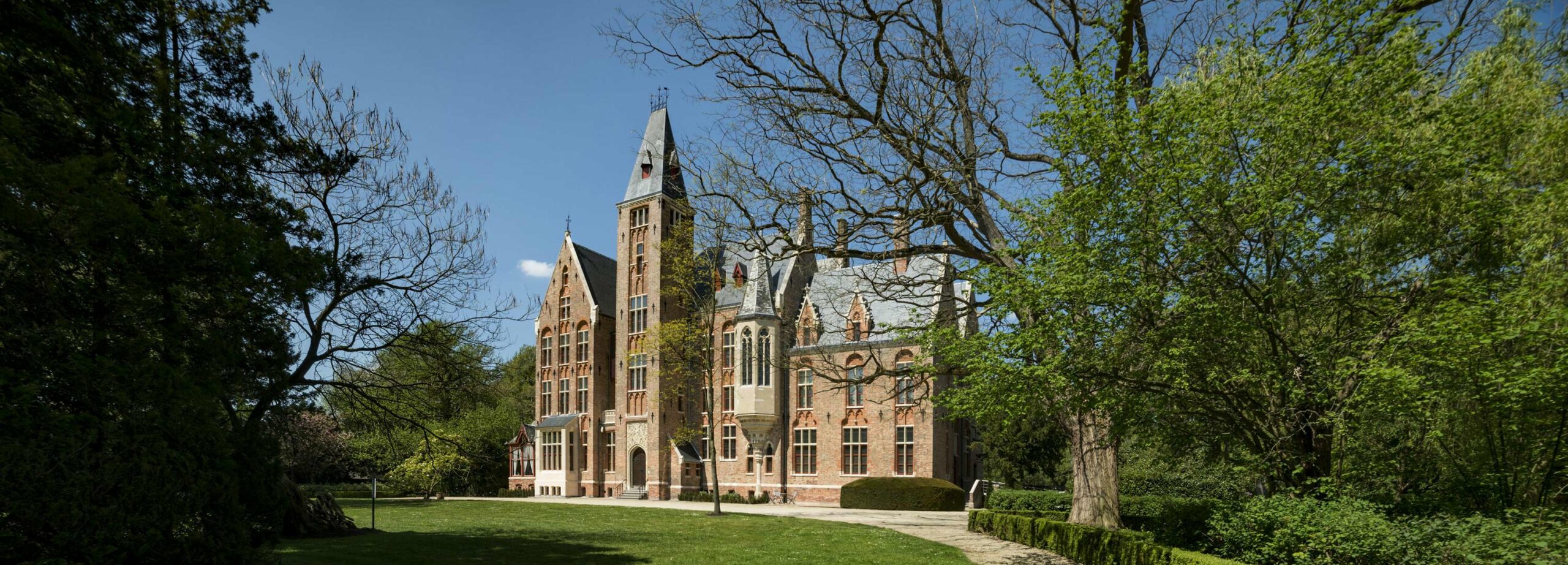
A few kilometers from Bruges, close to the Oostende-Brussel motorway, stands Loppem Castle, an impressive House (kasteel/château) built between 1858 and 1863 in the, at that time, predominant Neo-Gothic style and surrounded by a romantic English garden with its maze of red and green hornbeam and several ponds and grottos.
Baron Charles van Caloen and his wife, Countess Savina de Gourcy Serainchamps, commissioned the plans from the British architect Edward Welby Pugin, who was succeeded by his Belgian counterpart, Jean Bethune. The interiors, the decoration and furniture are preserved in their original state and are in perfect harmony with the Neo-Gothic architecture.
The ‘castlehouses a rich art collection assembled over the years by different members of the van Caloen family comprising medieval sculpture, Flemish paintings, stoneware, alabasters, illuminated manuscripts, prints and drawings.
The castle played also an important role in the history of Belgium. King Albert I and Queen Elisabeth stayed here in 1918. The so called “Loppem government” formed at the castle agreed on ground-breaking political and social reforms such as the introduction of universal male suffrage and the recognition of trade union rights.
Our Programme
10.00-10.30: welcome coffee or tea served with pastry
11.00-12.15: guided tour of the garden by Chris Ghyselen, the owner (English)
12.45-14.45: lunch in restaurant” Ten Voute”, located Steenbrugsestraat, 24 8210 Loppem close to Loppem castle (a 5min’ walk). https://maps.app.goo.gl/ArsgW1dZxd8TfpB57
How to get there: return to the E40 direction Ostende /Brugge. Take exit 7b to the N397 direction Loppem/Zedelgem. Take the N309 in Zedelgem. The restaurant is on your right.
Further information will be provided in additional guidelines which will be sent to the participants in the week preceding the outing.
15.00-16.30: guided tour of Loppem castle in English and Dutch.
16.30-17.30: aftertaste drink in restaurant “ Ten Voute’ (optional)
How to get there:
By car: from Brussels take the E40 to Oostende and get off in Aalter where you take the Knokkelaan /N44 to Knesselare. There you turn to the left and continue on the Kloosterstraat and the Knesselarestraat /N337. In Oedelem turn to the right for the Tinhoutstraat, 36. You will find the garden to your right. ( https://maps.app.goo.gl/NSQn2rvVrcQR9R128 )
Driving time: 1u10 (84 km)
By public transport: As it is difficult to reach Oostveld garden by public transport, the organizer would appreciate it if members/participants expressed their willingness to facilitate car-pooling as much as possible or to communicate their readiness to offer a lift to participants or would be participants less mobile.